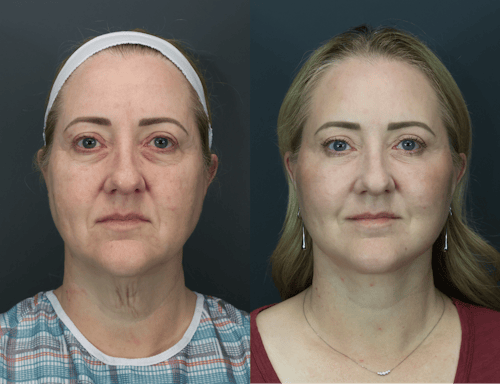
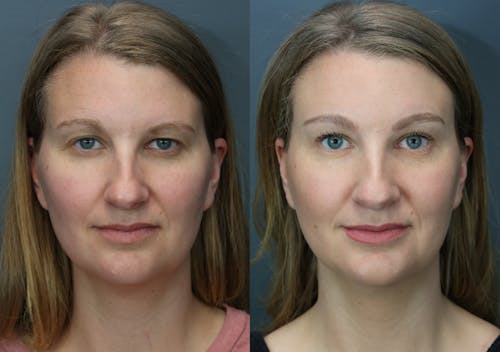
Direct
A direct brow lift removes the skin and muscle in the superior border of the forehead, just above the eyebrows. A small incision is made at the top of the eyebrow, where a small amount of skin and muscle is removed.
The advantage of a direct brow lift is the fact that it provides the most amount of brow lift per millimeter of tissue being excised. The disadvantage is the visible scar after surgery, though those with “bushy” eyebrows can hide it more easily. A direct brow lift is a good option for older patients seeking to enhance their brows, as well as for balding men seeking to raise their hairline.
Mid-forehead
During a mid-forehead brow lift, an incision is made within the forehead crease to remove excess skin and fat. An advantage of a mid-forehead brow lift is the fact that the tissue that surrounds the incision area will already be lax, which means the surgeon can remove less of the patient’s skin in order to raise the brows. A disadvantage is that the patient will experience visible scarring and a change in forehead sensation.
The mid-forehead brow lift is a good option for those who have a receding hairline, sagging brows, and/or deep forehead wrinkles.
Temporal
A temporal (or “lateral”) brow lift is a procedure in which the patient has surgery on a smaller portion of the eyebrows instead of the complete brow area. The majority of the incisions are hidden within the scalp, with a small portion placed on the temples, predominantly within hair-bearing scalp (although some of the incisions may extend to non-hair-bearing skin).
Advantages of a temporal brow lift include a lower risk and a faster recovery time because it is a less extensive procedure that requires less dissection. However, compared to other brow lift techniques, the temporal lift achieves less dramatic results that typically last 3 to 4 years.
Endoscopic
Many surgeons prefer the endoscopic brow lift procedure because it allows them to view and carefully dissect the forehead tissue using a small endoscope, typically attached to a camera. Endoscopic brow lifts also require smaller, less invasive incisions, which help minimize discomfort, numbness, and recovery time for patients.
During the procedure, multiple tiny incisions are made behind the hairline, with little to no skin being excised. The forehead skin will be repositioned and secured in an elevated position. This procedure is a good option for those in their mid- to late 30s with minimal upper eyelid drooping.
Pretrichial
With a pretrichial brow lift, the incisions are made just before the hairline, and they go from one ear to the other—although if just one brow requires surgery, the incision can be limited to just one side of the face. An advantage of a pretrichial brow lift is its ability to keep the hairline from being elevated, which can be an issue if the patient already has baldness or a receding hairline. A disadvantage is that the incision scar may be more prominent.
A pretrichial brow lift is a good option for patients with taller foreheads, as skin removal will lower the hairline.